Recollections
T . H . E . . E . A . R . L . Y . . Y . E . A . R . S
Personal memories
recall landscapes and lifestyles
of a bygone era
|
The Baseball Diamond
and other childhood adventures on the former Willows Fairgrounds in the early 1950s |
|
by Gary Wilcox
OBHS class of 1960 |
|
Gary Wilcox photo
|
 |
|
.
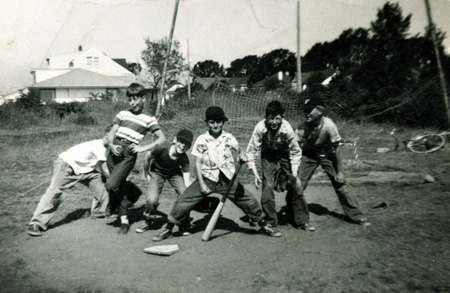
The Baseball Diamond (1954)
.
Impromptu baseball pitch in northwest corner of former Willows Fairgrounds |
|
In 1951 our family moved into 2080 Allenby Street — just across the street from the former Willows Fairgrounds and racetrack. The old exhibition buildings were barely gone. What remained was a large open field with incredible history. And endless possibilities for a nine-year-old.
|
||
|
With its bush forts, winding trails through tall grass, wild blackberries, assorted wildlife encounters, the trill of skylarks, and the pure joy of tadpole swamps, the old fairground was about the best vacant lot a kid could ask for.
|
||
|
THE FROG AND TADPOLE ENTERPRISE |
||
| The frog ponds were about where Neil and Eastdowne intersect today. We spent many happy hours catching these slimey little creatures — in fact I turned my catch into a viable business. I posted a sign on the telephone pole in front of our home advertising tadpoles – 5 cents, and frogs – a dime. I think I even had some sort of guarantee. Cars would stop and parents would buy them for their kids. | ||
|
||
| Usually I'd be out playing in the fields so my mother often handled the sales and, for a brief period, was known as the "frog lady." Did quite a business, even supplied the downtown pet shop until the tadpoles morphed into frogs and escaped to infest the store. But I ended up with enough nickels and dimes to buy the aquarium I was saving for. It was heaven for a nine-year-old. | ||
|
SKYLARKS |
||
|
The joyous trill of skylarks over Oak Bay meadows is sadly missed by those who remember.
|
||
|
Click on play to enjoy the musical trill of the English skylark |
||
|
THE ROLLER RINK |
||
| After the exhibition buildings were gone by the late 1940s, a concrete slab remained about where Haultain meets Eastdowne. | ||
| This was the foundation of the Industrial building. As this foundation didn’t impede planned roadwork, it sat on the landscape for several years and became a community roller rink from the late 1940s through the early 1950s. | ||
| We spent countless hours wearing-out roller-skate wheels on this slab. We particularly liked playing hockey after it rained because we could slide sideways, like on ice. | ||
|
THE BASEBALL DIAMOND |
||
| When we lost our concrete slab we turned our attention to baseball, and built our own diamond slightly southeast of where Henderson and Neil intersect today (see above photo). This was the northwest corner of the former fairgrounds. By this time we were eleven years old and playing Little League baseball in Victoria. This practise diamond we built in Oak Bay, complete with custom backstop, was a marvel. | ||
|
THE BASEBALL INCIDENT |
||
| Our baseball diamond invited many impromptu games with neighbourhood little leaguers. On one particular occasion there was this girl watching us play, so we invited her to join us. We had never played baseball with a girl before, but didn't give it much thought — until it was her turn at bat. | ||
| She hit an infield grounder to shortstop, which was easily scooped up and thrown to first. Easy out! Except she was nowhere in sight. Instead of running to first base she ran to third base and, needless to say, arrived safely. | ||
| We were dumbfounded. But she stood on third, defiantly holding her ground. She argued that she ran to third because she was left-handed! | ||
| After that, baseball was pretty much a guy thing for a few years. | ||
|
* * *
|
||
| By the end of 1954 our carefree little world began to disappear as the fairground was subdivided. Streets went in, houses went up, and the skylarks moved on. | ||
| The fairground days are long gone. A house sits unknowingly on our baseball pitch. I can't remember what possessed me to take that photo in 1954, but the image of our hand-crafted baseball diamond has become a cherished reminder of my boyhood days in Oak Bay during the early 1950s. |

The History of Oak Bay Website
A CENTENNIAL LEGACY PROJECT