Recollections
T . H . E . . E . A . R . L . Y . . Y . E . A . R . S
Personal memories
recall landscapes and lifestyles
of a bygone era
|
Child's Play
Growing up in south Oak Bay in the 1950s and '60s |
|
by Barbara Julian
|
|
courtesy Barbara Julian
|
 |
|
.
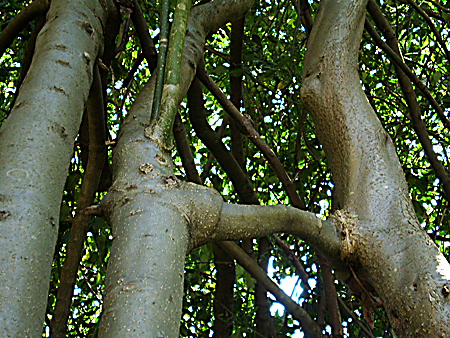
Holly Hedge Fusion
.
|
| The holly farm in south Oak Bay yielded to a housing subdivision, but a few trees still exist as a hedge. "It's so amazing the way the separate trees fuse at points up and down their trunks." — Barbara Julian |
|
McNeill Avenue marks today what had been the northern boundary of a farm stretching north from McNeill Bay (Shoal Bay), owned by Captain McNeill.
|
| HOLLY FARM |
|
When the Runnymede Place/McNeill Avenue area was subdivided for single family dwellings, the first lots were carved out of a holly farm owned by two unmarried sisters.
|
| Mrs. Betty Roberts moved from Manitoba with her new husband after World War II and had one of the first houses built — one of four in a row in the 2000 block McNeill. |
| A row of the original holly trees formed the back boundary of these new lots. This still exists as a hedge, made up of twisting blended mature trees now overshadowed by younger evergreens and multiple houses. |
| GROWING UP IN THE 1950s & 1960s |
| Growing up in the same McNeill/Runnymede/Foul Bay Road neighbourhood in the 1950s and '60s it was usual for kids five or six years old and up to run off to play independently in the neighbourhood, without adult supervision and having only to "be home by dinner." |
| A WORLD OF NATURE AND IMAGINATION |
|
There was a large garden behind the Roberts house on the north side of the top of McNeill Avenue. We neighbourhood children slipped through the fence and found ourselves in what felt to us like thick woods. Climbing up towards the large stone mansion of which this was the garden, it was easy to pretend we were lost in deep wilderness. We scrambled over fallen branches and rocky outcrops, dodging holly prickles and (we pretended to think) poisonous snakes and spiders.
|
| We had to keep ourselves hidden because behind the leaded glass windows in the stone towers of the house there lived, of course, a witch. Also a misshapen monster-man. |
| Despite these threats (which we may have based on the real possibility that some angry adult would object to our trespassing) we explored further every time until the wondrous day when we discovered a pond in which swam, silently and miraculously, some huge and rather sinister-looking fish. Contemplating these fish, under the watching eyes of the witch, hidden in the dappled shade of the old trees where birds chirped and secret rustling sounds arose from all around, we felt we were a million miles away from our own house. It was just across the road, yet our own grassy garden, our toys, the house, its familiar rooms, the family car all seemed like objects from another life. |
|
PARADISE LOST
|
| Today, that large uncultivated urban garden we had found so magical has been subdivided for the "Edgecliff" development containing several large expensive new houses. The houses across from our childhood home are still there, but behind them where the secret garden once was, massive new boxes now loom whose windows peer over the old hedges. |
| No children in this neighbourhood will any longer have a forest to explore, where they can scramble over rock or lean on mossy tree trunks in summer heat, hidden for a moment of tranquil privacy from parents and neighbours. Parents today tend to keep their offspring out of hidden woods for safety reasons, fearing not fairy-tale witches but the kind of monster which the adult mind conjures up. |
| This accessible wood was not the only part of south Oak Bay which we kids visited and which most parents today would consider dangerous. |
| SHOAL BAY |
| It was not far to Shoal Bay, and by the age of six every child could ride a bike (that was the age we started at Monterey School, to which everybody rode), so we rode to the beach to hop along logs and cliffs as far as "the point" at the end of the bay. |
| Sometimes we would then find that the tide had come in and the logs we had used to travel along were now bobbing about in deep water, as the sun sank in the west and an evening chill developed. |
| We would not think of trespassing through one of the gardens which backed onto the beach, where people would be preparing dinner behind lighted windows and would not want strange bedraggled children prowling through their gardens. |
| We avoided adult attention and just took the risks that were required, inching along the bobbing logs and slippery rock, pretending to be smugglers and sometimes getting very wet. |
| We could see Trial Island just offshore and frequently planned to build a raft to take us there. We began the raft many times, using logs and hammers and bent nails smuggled from our parents' basements, but we never managed to finish a seaworthy one. |
| MORE FANTASIES |
| Other gardens in the neighbourhood held other delights and inspired more fantasies which we, on the days we were lucky enough not to have a piano lesson or some other unwelcome class, looked forward to elaborating after school. |
| THE MIDNIGHT BOAT |
| On the bend of Runnymede Place is a stone outcrop which all the neighbourhood kids agreed had the shape of an ocean liner. There was even a ledge-like recess near the "prow" for the captain. Many journeys were taken on this craft, which we called "the Midnight Boat." Why midnight? It was only years later that I realized we must have got the name from the CPR boat that had once gone overnight to the mainland; we must have heard adults refer to it. But more than that, the name came because we imagined ourselves far out upon the ocean under the stars, and midnight was a special time, the hour we never saw, so naturally we endowed our magical boat with its flavour. |
| PURE, SMOOTH, DELICIOUS BROWN MUD |
| One neighbourhood family had the sense to leave one bed of their cultivated garden as a pit of pure, smooth, delicious brown mud. Given a few receptacles and kitchen implements, it is amazing how many hours a kid can pass in a mud puddle. It was a very tactile and sensuous way to play. |
| BACKYARD CREATURES |
| Then there was the yard that had the raspberry patch, where all the entomologically-minded kids caught the poor bees hovering around the flowers, keeping them in jars with air holes and leaves, in which unfortunately they always died. They could always however be replaced by the furry caterpillers we occasionally found inching along the rims of planters. We had no idea that these cute softly attractive creatures were "pests". Nobody seemed to kill them with pesticides, yet no garden ever became less lush as a result of their presence. |
| CLIFF DIVING |
| Then there was another property containing another huge rocky outcrop, one side of which dropped straight down like a cliff. Beneath this in the fall we piled mountains of leaves gathered from the surrounding oaks and other deciduous trees. Everyone would take turns lining up at the top of this rock and leaping off onto the leafy mattress below. No adult was ever present, and no child ever had more fun by using a manufactured trampoline at a gym. |
|
|
|
When we were older
we visited real islands on real boats, got taken on trips by car and experienced more ambitious hikes, yet none of those experiences ever occluded that first heady sense of freedom in nature that those early outdoor free playtimes imprinted on our brains. |
|
|
| Another favourite adventure was to climb up Gonzales Hill to what was then the "weather station" and the sister peak (now Walbran Park), from which we could look down on a magic carpet of greenery, a dense urban canopy stretching from the hill right back to our homes on McNeill Avenue, and beyond. |
| Sadly, that urban woodland is now being steadily subdivided and broken up for housing development. Will future children living in the new houses still have a nature-rich playground around them, and the 1950s-style freedom to play in it which former Oak Bay kids had? |
This submission is adapted from the Intro of Barbara Julian's
Childhood Pastorale: Children, Nature, and the Preservation of Landscape,
available at various bookshops such as Ivy's and Overleaf Books.

The History of Oak Bay Website
A CENTENNIAL LEGACY PROJECT